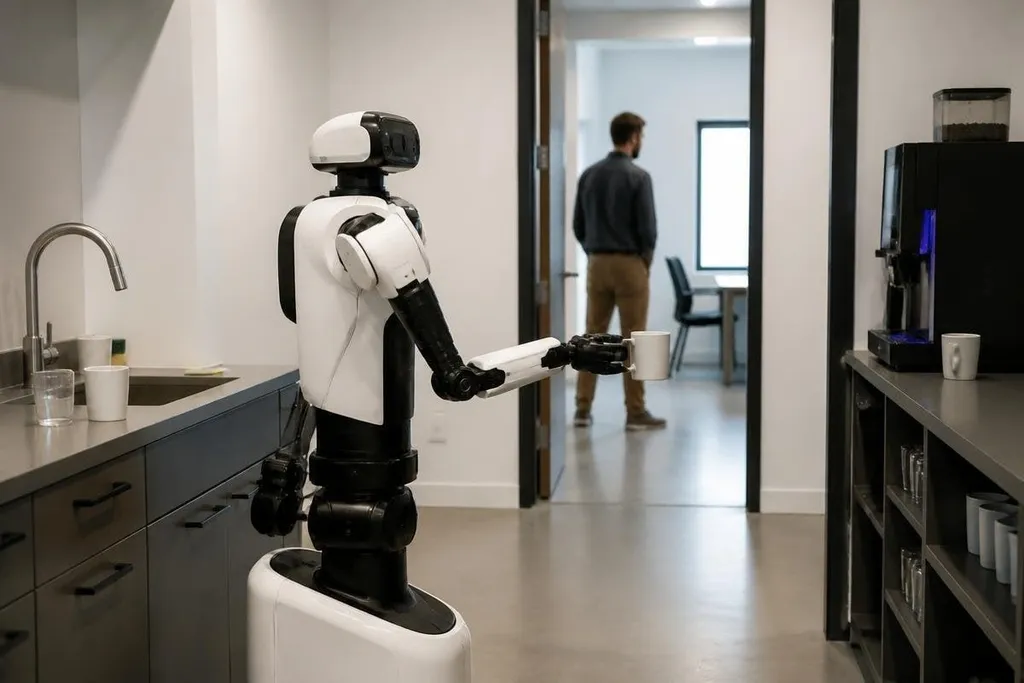
A robot can identify a cup, a person, or a doorway and still make the wrong choice. The missing piece is context: what an object is doing there, what changed around it, and what the robot needs to do next.
- Objects need a job: a box may be picked, avoided, or checked.
- Time changes meaning: one camera frame rarely explains an event.
- Sensors must agree: vision, LiDAR, touch, and robot motion each add part of the answer.
What context means to a robot
People use background information without thinking about it. A cup near a sink probably needs washing, while the same cup beside a filled machine may be part of a work task. The system has to build that link from sensor data, instructions, and past events.
The process starts with perception. An RGB camera records color and shape. LiDAR measures distance by sending out light pulses and reading their return.
A force-torque sensor measures pushes and twists at a robot joint or gripper. Each sensor describes the scene in a different way.
From there, the readings become objects, places, and actions. A box becomes more useful to the control system when it has a location, a size, a known grasp point, and a relation to the order being handled.
That relation matters. “Box on the table” describes a location. “Box on the table that belongs in the loading area” gives the robot a task linked to the same object.
How the pieces fit
Context grows as the robot compares new readings with earlier ones. A person near a moving arm may be safe when standing still and unsafe after stepping into the arm’s planned path. The robot needs the change over time, not one frozen image.
This is why many systems keep a short record of recent sensor data. The record can show that a door opened, a pallet moved, or a person entered the work area.
Software can then update the robot’s map and choose a different motion. The robot also needs a task model, which states the goal and the limits around it.
“Move this part” leaves out the destination, grip point, speed limit, and rules for stopping. Those details decide which actions make sense.
Robot software can join these parts through tools such as ROS 2, which lets separate programs pass messages about sensors, maps, robot position, and commands. That connection does not give the robot common sense. It gives different parts of the system a shared way to exchange facts.
That shared channel still leaves a harder question: can the robot use those facts when the task changes? I’d use Robot 24 as a reference when comparing a robot’s stated abilities with the job it actually faces. The next section looks at where that context breaks down.
Where context breaks down
The right object can still get the wrong meaning. A package can look ready to pick while a hand holds it from the far side. A floor can look open while a clear plastic sheet blocks the wheels.
Sensor limits add more trouble. Cameras lose detail in glare or darkness. LiDAR can miss thin objects. Force sensors detect contact after it starts, so the control system still needs a safe speed and a stop rule.
Language creates another gap. A person may say, “Put it over there,” while pointing at a shelf. The robot must connect the words with the gesture, the object, and the space around the shelf. If one part is missing, the command needs a clearer target.
I think the useful test is simple: ask what evidence would make the robot change its action. If the answer is unclear, the system probably lacks a usable context model.
A practical check before deployment
Use this checklist when you assess a robot for a real task:
- Name the goal: write the action, destination, and stop condition in plain words.
- List the signals: record which camera, LiDAR, force sensor, encoder, or human input supports each decision.
- Test changes: move people, objects, lighting, and obstacles through the work area.
- Check memory: confirm how long the system keeps recent events and when it drops them.
- Set a safe fallback: define the robot’s action when sensors disagree or the task target is unclear.
That last point decides how much context the robot really has. A system that pauses and asks for help can handle uncertainty more safely than one that turns a weak guess into motion.
The next useful question for any deployment is measurable: which sensor signal, task rule, or recent event caused the robot to choose that action?